Sunday, December 2, 2012

"A Child Has No Voice"

by Linda Ann

Green Valley, Arizona December 2, 2012 - Released yesterday on Amazon.com, this true story was experienced by a child many years ago and told as an adult many years later. It is a story of child abuse and abandonment set initially in post war Chicago Ill in the late 40's. The book tells of a young couple from very different ethnic backgrounds, and their struggles to make it in spite of limited education, family disfunction, mob affiliation, alcoholism and gambling. Without the benefit of parental guidance and nurturing themselves, this young couple tried to cope the best way they could, but it wasn't enough to keep their young children from experiencing child abuse, extreme cruelty and  at times abandonment. When a child stops smiling in the family photo's, something is wrong. It is estimated there are 60 million survivors of sexual abuse in America.

This book is currently available in paperback version on Amazon.com at, http://www.amazon.com/Child-Has-No-Voice/dp/1479132934/ref=sr_1_1?s=books&ie=UTF8&qid=1354462281&sr=1-1&keywords=A++Child+Has+No+Voice.

I personally recommend this book.

Bob Bonville

Saturday, November 17, 2012

Kumu Oli

Kumu Oli - To understand What, and Who the Kumu Oli is, one must first understand a bit about the ancient, sacred art and skill of Oli.

The Oli (Hawaiian Chant) falls into two broad categories, mele oli and mele hula. Mele oli are chants delivered with no musical instruments and are generally performed by one individual. However, mele hula are chants accompanied by dance and or musical instruments and are often performed by a group. Within these categories are dozens of kinds of chants, formal and informal, for specific occasions and purposes. Each type of chant was performed in a specific way and style. For example, kepakepa style (rapid rhythmic recitation) for prayer chants, ho‘āeae style (soft and short drawn-out vowels) for love chants, ho‘ouweuwe style (heavier voice with protracted vowels) for wailing or lamenting chants, and koihonua style (distinctly pronounced words) for genealogical chants.

The mana (spiritual power) of an oli lies in its themes and kaona (hidden or double meanings). Hidden meanings, such as rain as a metaphor for love, or the lehua blossom as a metaphor for warrior could make a chant both a recounting of an actual event, or speak of love and war depending on who heard and understood the chant. As such, the oli may be understood on different levels by different people. Whether speaking of actual events or filled with metaphors, the oli reflects a people and culture that are quick-witted, poetic, and finely attuned to nature in their imagery, themes, and kaona.

With no written language, the ancient Hawaiians depended on the oli as their primary art form to preserve oral histories and traditions such as genealogy, special places, important events, and prayers. As such, the oli was the very life blood that preserved and perpetuated the Hawaiian culture. Individuals were chosen in their youth and received special training to oli and become living historians and genealogist. The oli was accurately committed to memory sometimes covering over a hundred generations and several thousands of years. Today, the oli is referred to as the “soul” of the Kanaka ‘Ōiwi (aboriginal peoples of Hawai‘i) and is recognized at the highest form of the Hawaiian language.


A man I have never personally met, but have come to know and admire greatly through Facebook is a Hawaiian Chant (Oli) master "Kumu Oli." His name is Sam Ohu Gon III. A Senior Scientist/Cultural Advisor at the Nature Conservancy of Hawaii. Please follow this link https://www.facebook.com/#!/notes/sam-ohu-gon-iii/questionnaire-on-being-a-kumu-oli/10151233000072311

Mahalo for learning a little about Kumu Oli.
Palolo Bob

Wednesday, November 7, 2012

Honi- Hongi


Honi-Hongi

Honi- To Kiss; A Kiss; A Hawaiian Greeting

Formerly to touch noses on the side in greeting.

The honi is a Polynesian greeting in which two people greet each other by pressing noses and inhaling at the same time. This is a very honorific as this represents the exchange of ha--the breath of life, and mana--spiritual power between two people. This act and the concepts behind it are very unusual to western audiences and care should be taken to explain the spirituality and sacredness of this simple act of greeting.
 

Hongi- To the Maori

A hongi is a traditional Māori greeting in New Zealand. It is done by pressing one's nose and forehead (at the same time) to another person at an encounter.
It is used at traditional meetings among Māori people and on major ceremonies and serves a similar purpose to a formal handshake in modern western culture, and indeed a hongi is often used in conjunction with one.
In the hongi, the ha (or breath of life), is exchanged and intermingled.
Through the exchange of this physical greeting, one is no longer considered manuhiri (visitor) but rather tangata whenua, one of the people of the land. For the remainder of one's stay one is obliged to share in all the duties and responsibilities of the home people. In earlier times, this may have meant bearing arms in times of war, or tending crops, such as kumara (sweet potato).
When Māori greet one another by pressing noses, the tradition of sharing the breath of life is considered to have come directly from the gods.
In Māori folklore, woman was created by the gods moulding her shape out of the earth. The god Tāne (meaning male) embraced the figure and breathed into her nostrils. She then sneezed and came to life. Her name was Hineahuone (earth formed woman).

Tuesday, October 30, 2012

Pineapple

The Pineapple


Named Hala kahiki by the Hawaiians,  a tropical plant with edible multiple fruit consisting of coalesced berries, named for resemblance to the pine cone, is the most economically important plant in the Bromeliaceae family. Pineapples may be cultivated from a crown cutting of the fruit, possibly flowering in 20–24 months and fruiting in the following six months.
Pineapple may be consumed fresh, canned, juiced, and are found in a wide array of food stuffs – dessert, fruit salad, jam, yogurt, ice cream, candy, and as a complement to meat dishes. In addition to consumption, in the Philippines the pineapple's leaves are used as the source of a textile fiber called piña, and is employed as a component of wall paper and furnishings, amongst other uses.
Unlike many other fruits, pineapple does not ripen post harvest, so it is picked when it is ripe. Recently I heard two people talking about this wonderful fruit and their discussion went to the origin of this delectible treat. One said to the other, "I think the Dole family invented it genetically and started a farm in Hawaii." The other did not disagree but said they heard a similar story but it was the Delmonte family. Thinking this was an absurd assessment on the subject of the origin of the Pineapple I decided to look it up. What I found was surprising. Was the origin indeed Hawaii, Samoa, Tahiti, Indonesia or just where? If you don't know, venture a guess, you may be surprised.


Mahalo for the visit.

Aloha
Palolo Bob

Friday, October 26, 2012

Priest - Kahuna


The Priest - Kahuna

Kahuna - http://www.huna.org/html/kahuna.html

Kahuna is a Hawaiian word, defined in the Pukui & Elbert (1986) as a "priest, sorcerer, magician, wizard, minister, expert in any profession".Forty different types of kahuna are listed in the book Tales from the Night Rainbow. Kamakau lists more than 20 in the healing professions alone, including for example "Kahuna la'au lapa'au" (an expert in herbal medicine) and "kahuna haha" (an expert in diagnosing illnesses).
With the revival of the Hawaiian culture beginning in the 1970s, some native Hawaiian cultural practitioners call themselves kahuna today. Others, particularly devout Christians, disdain the term. The word has been given an esoteric or secret meaning by modern followers of Max Freedom Long and Huna to emphasise a priestly or shamanic standing, however, those interested in true Hawaiian traditional mysticism must understand that "Huna" is not Hawaiian and should be wary of anyone using the term.

Many myths have grown up around kahuna. One is that kahuna were outlawed after the white man came to Hawai'i. Kahuna can be divided into three categories: "craft" kahuna, such as kalai wa'a, an expert canoe maker, and ho'okele, an expert navigator; "sorcerers" including kahuna 'ana'ana; and healers. Craft kahuna were never prohibited; however, during the decline of native Hawaiian culture many died out and did not pass on their wisdom to new students. As an example, when the Hōkūle‘a was built to be sailed to the South Pacific to prove the voyaging capabilities of the ancient Hawaiians, master navigator Mau Piailug from Satawal was brought to Hawai'i to teach the Hawaiians navigation.
Share your personal experience or bit of knowledge regarding these keepers of the culture.
Mahalo
Palolo Bob


Friday, October 19, 2012

The Great Moa of Aotearoa (New Zealand)


MOA -

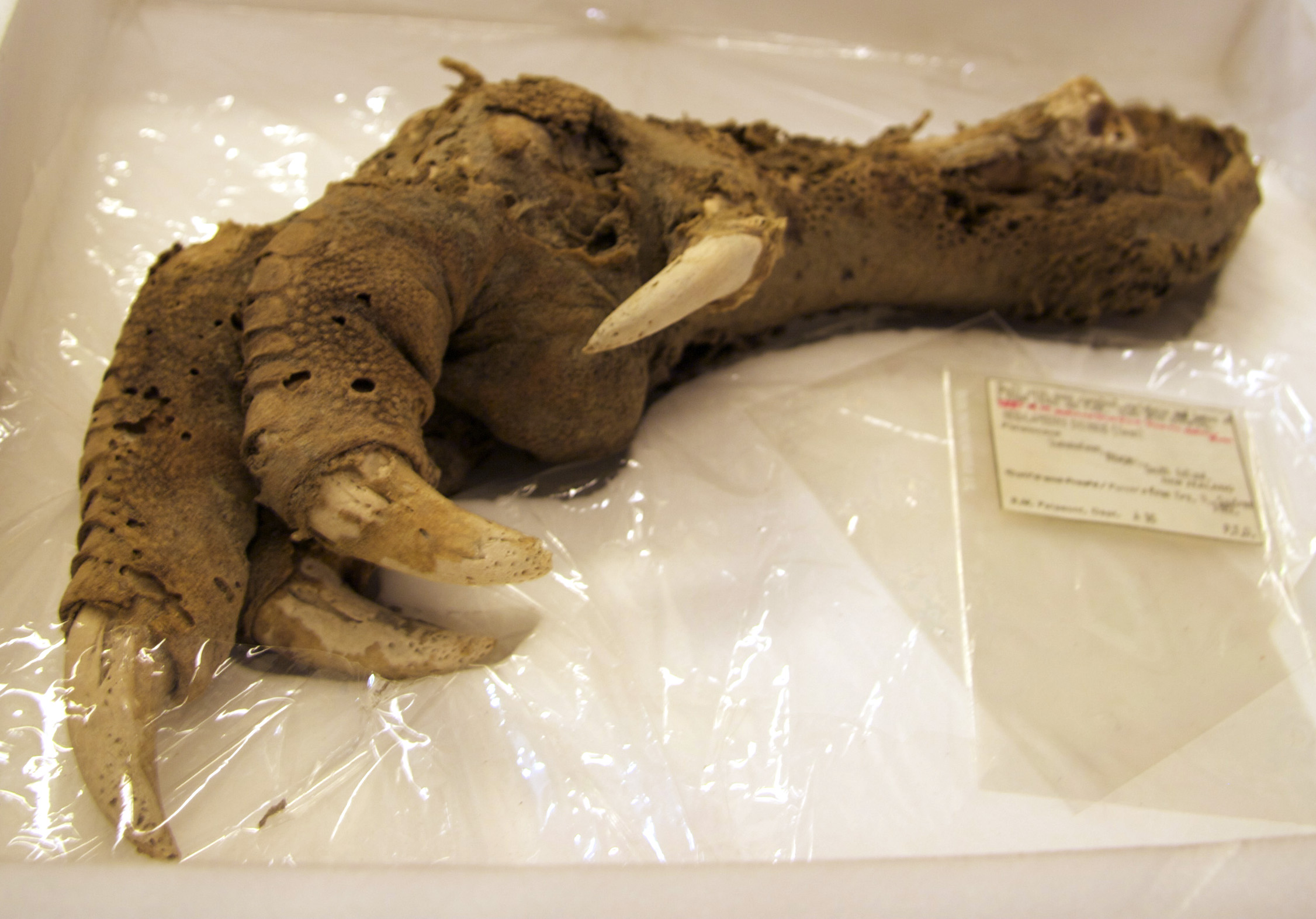
Flightless giant island-living bird was the New Zealand giant moa  a member of the ratite family. There were several species of moa, some taller than the elephant bird at 7 ft (2 metres) to the middle of the back and 13 ft (4 metres) to the head (twice the height of a tall man), although their necks probably projected forwards like a kiwi rather than upwards as usually depicted. They were more lightly built than the elephant bird, but still three times the weight of a large man at up to 200 - 275 kg. The Giant Moa's eggs measured 10 inches (24 cm) long and 7 inches (18 cm wide). Females were 1.5 times the size and almost 3 times the weight of males, leading scientists the revise moa classification and the number of moa species. In the past, the males and females had been erroneously considered different species due to this size difference. The moas occupied similar niches to mammalian herbivores elsewhere.
New Zealand was even more isolated than Madagascar and had no land mammals except bats. The first Polynesians arrived in New Zealand around the 10th century, becoming the Maori. The dominant life-forms were the giant land birds that lived in the fringes of the semi-tropical forests and on the grasslands and which the Maoris called 'Moas'. Encountering the huge birds, the Maoris made legends of the giant moa, calling it the Poua-Kai and describing it as a huge bird of terrific size and strength which, in a great battle, destroyed half the warriors of a powerful tribe with its terrible rending talons and thrusting bea.
Moas were huge ratite 'running birds' like the Elephant Bird, but they inhabited the grasslands and forest-fringe in extraordinary numbers and variety. Scientists later gave them the family name Dinornithidae, 'terrible birds'. The aggressive Polynesian invaders became a Moa-hunting culture and for the moa, which had had no predators in 100 million years, the effect was devastating.
Does anyone know why the Moa were not able to survive in this land so well suited for their existance?
Please offer your information and comment.
Aloha, Palolo Bob

Thursday, October 18, 2012

Kumu Keli'i Tau'a


Kumu

Though he didn't set out to become an expert on Hawaiian culture, Keli'i Tau'a may be the most revered teacher of hula and chant you never heard of.

It wasn’t until young Keli‘i Tau‘a’s feet hit the water that he remembered he’d never learned to swim.

The thirteen-year-old student at Kamehameha Schools in Honolulu had been raised in Kula, far from the ocean, but when, on a Saturday excursion to Waikiki Beach, his mates ran to the end of the concrete- and-stone breakwater and jumped off, he leaped too.
“Any human being does the natural thing—the dog paddle,” he chuckles. “But I was struggling. I let myself sink and thought, ‘Well, this is it,’ then I kicked myself up and started going again. When I looked ahead and saw all the tourists on the shore, I thought, ‘Man, I got a long way to go.’”

It wasn’t the last time Tau‘a would dive into something without knowing how deep it would be.

Today the sixty-six-year-old Ha‘iku resident is an acknowledged master of Hawaiian music and chant, and an expert in traditional ceremonies. Some of the Islands’ most respected cultural leaders consider him a mentor.

Because of his knowledge of ancient protocols, Tau‘a’s been called on to bless everything from new canoes to a jetliner. He’s led his hula halau, Maui Nui o Kama, for thirty-six years, and taught Hawaiian language and culture at Maui Community College for more than a decade. One of the most prolific Hawaiian-language songwriters living today, he has recorded more than a dozen albums of Hawaiian music and chant, collaborating with Hawaiian music greats like Roland Cazimero and Gabby Pahinui.

But while Tau‘a is revered by students of Hawaiian culture, many people outside that community don’t even recognize his name.

“He just flies under the radar,” says Clifford Nae‘ole, cultural advisor to the Ritz-Carlton, Kapalua.

Nae‘ole learned hula from Tau‘a, and says that, as a teacher, Tau‘a was strict, exacting and old school. “What mattered to him was the culture, the protocol. We would practice in the morning, early, before the sun came up sometimes. Sometimes we’d practice late at night. He was saying, ‘How much do you want this? Show me what you want, and that’s what you will receive.’”

Nae‘ole says Tau‘a’s humility, a product of the Hawaiian spiritual traditions he follows, and his intense devotion to studying and teaching rather than self-promotion, are some of the reasons he isn’t better known in the wider community.

That may be changing. Tau‘a recently returned to the recording studio after more than a decade. He released a lyrical album, Cloud Warriors, in 2008, and a new album of chant, E Ala Hawai‘i, earlier this year. An album of songs inspired by the voyaging canoe Hokule‘a is planned for release in September. And last April, at the Ritz-Carlton, Kapalua’s Celebration of the Arts, Tau‘a received Na Mahana Award of Excellence in recognition of his lifetime of dedication to Hawaiian culture.

This fine man, champion of Hawaiian Studies and accomplished musician, helped me enormously while I was writing my book. Please take a moment to visit his website to learn more about him and his work at, http://www.keliitaua.com
Mahalo and Aloha
Palolo Bob
www.authortobertbonville.com